How to Read Marching Band Bass Drum Line Sheet Music
Drum notation is a course of writing downward music specific to percussion instruments. It's quick and like shooting fish in a barrel to learn. Think of it as a language for drums. If you lot know how to read and write drum notation, so you know how to communicate musically with others.
To read drum notation, y'all need to learn the different symbols. These symbols tell you what part of the drum fix to play and when. By learning how to read drum notation, you'll be able to quickly play a rhythm or pulsate beat, even if you've never heard it before.
 Play
Play 
WHAT IS Drum Note?
Pulsate notation is different than canvas music, although they wait like and use some of the same concepts. In sail music, the symbols on the staff correspond to unlike notes. In drum notation, the symbols correspond different parts of the drum prepare (snare, hi-hat, bass drum, etc.) to exist played. This is useful for beginners learning to coordinate their limbs, helping to develop the necessary skill sets to both comfortably proceed steady time and play the correct part of the drum set.
In drum notation, the symbols represent unlike parts of the drum prepare
In drum notation, the notes are written on the staff and are separated by vertical bar lines. The space betwixt the bar lines is referred to every bit a "measure." You will typically count beats while playing different notes on the drum prepare within each measure.
Drum annotation does contain similarities to sheet music in that measures are counted and read the same mode. Past learning to read and write this part of the musical language, y'all'll develop a stiff sense of timing and rhythm command.
How to read drum note
Like the English language, drum annotation is read from left to right. The staff is fabricated upward of v lines and 4 spaces, merely notes can exist positioned to a higher place or below the staff as well. Notes are placed in the staff based on which role of the drum prepare should be played at any given time. Notice below that the bass pulsate is in a dissimilar position on the staff than the snare or ride cymbal.
Drums are notated by dots, while cymbals are notated with an "x." These symbols typically take "stems" attached to them, which help explicate how to count the beat that is shown.
Reading drum notation
At that place are several symbols musicians should know when starting to read pulsate annotation, especially if they're only starting off with a four- or five-piece drum gear up.
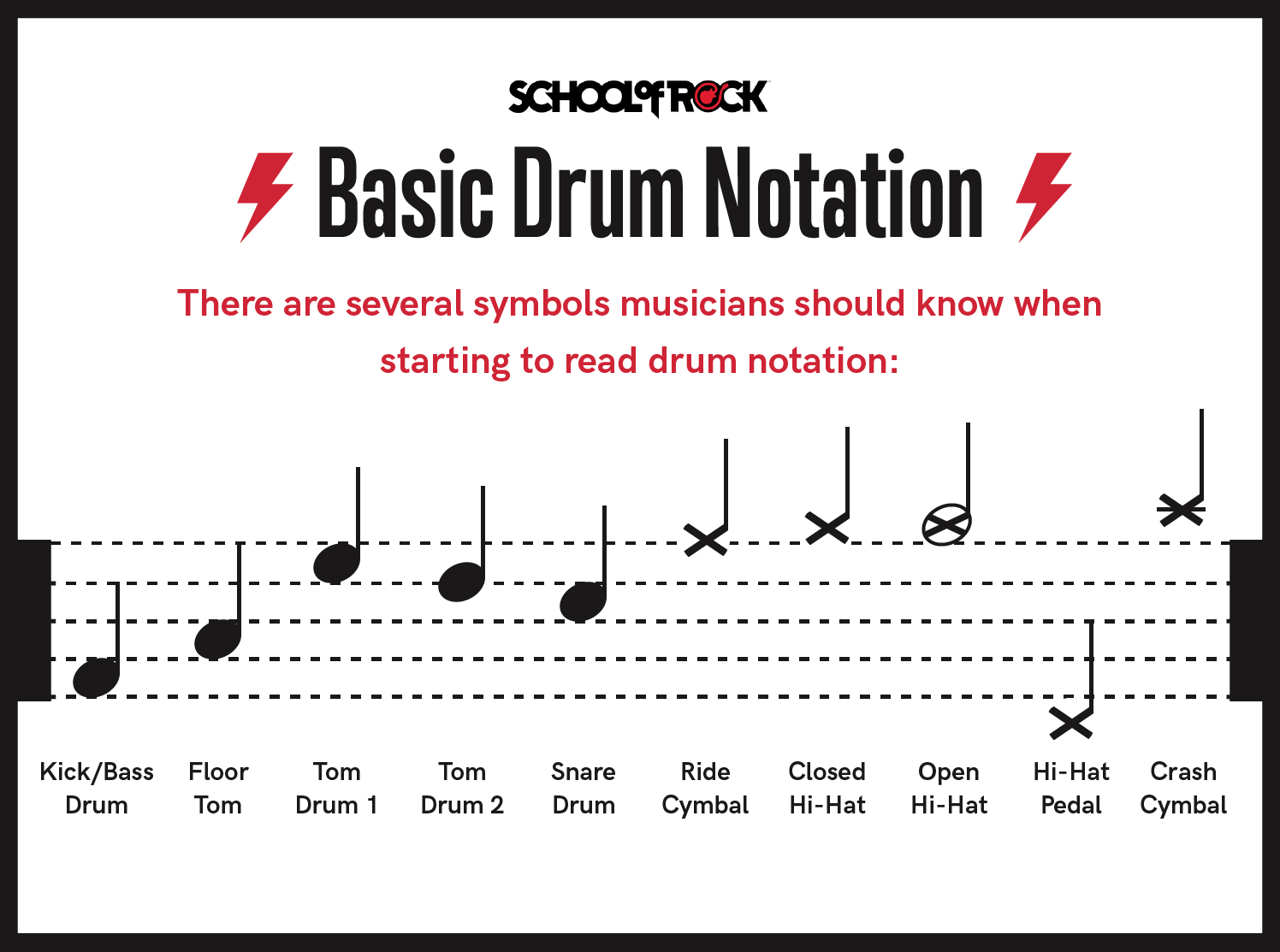
- Bass. Note for the bass drum sits in the bottom space of the staff. The bass drum is typically the biggest drum on the drum gear up, and usually produces the lowest note. Information technology is used with a foot pedal and is oftentimes referred to as the "kick drum."
- Floor tom. Notation for the floor tom sits in the tertiary infinite from the top of the staff. The floor tom (or low tom) is typically the next everyman annotation on the drum prepare. Information technology is often referred to as a floor tom considering it may rest on the floor by using legs.
- Tom ane and tom two. Toms are notated on the first infinite from the tiptop of the staff and the line below that space. Sometimes called the loftier tom, this drum typically produces a note higher than both the floor tom and bass pulsate. Many drum fills are started on this drum, and many drum sets have more than than one tom.
- Snare. The snare pulsate is often considered to be the main drum of the drum ready. Its notation is located in the second space from the pinnacle of the staff. Many pulsate beats are based around the pattern between the bass drum and snare drum. It gets its famous snare sound from the snare wires that are attached to the bottom head of the drum.
- Ride. This cymbal is often the biggest on a drum kit and is used for many different purposes. The ride cymbal is often tapped with the tip of the stick to create a feeling of "riding," merely it can also be used as a crash cymbal. On the staff it'south located on the very superlative line.
- How-do-you-do-hat. The hi-lid notation sits in a higher place the top line on the staff, and is ofttimes a main time-keeping tool. The hello-hat is a pair of cymbals that are used with a unique blazon of stand that contains a foot pedal. Drummers can command the type of annotation that'south produced by stepping on the hi-lid pedal and tightening the ii cymbals together and and then striking them, known as closed hi-chapeau, or letting them lightly bounce off of each other by releasing force per unit area with the foot, known as open hi-hat.
- Crash 1 and crash 2. A crash cymbal is a very loud, large cymbal that is often used to accent different rhythms within music. Crash cymbals vary in size and tone and contain a big number of different styles and sounds. This cymbal differs from the others on the drum set because it'south often struck with force and can help elevate the dynamic movements of a piece of music. Its annotation is located above the hi-hat, above the top line on the staff. On drum sets with two crash cymbals, the second crash volition exist notated in the space above the first crash.
Reading the music staff for drums
Music is frequently divided up into even (or sometimes odd) groups of space. Nosotros utilise "measures" in music to organize the rhythms of the song into these repeated groupings to make it easier to count through a song. To communicate what group we should count, we use what'due south called a fourth dimension signature.
Reading time signatures
A time signature contains two numbers displayed every bit a fraction. The top number tells you how many beats to count inside i mensurate, and the bottom number tells yous what type of note gets the beat (quarter notes, eighth notes, etc). Think of the time signature as ruler. You're measuring time, or more than accurately, the space between the notes that you're playing.
For case, a quarter annotation in a iv/4 time signature represents one beat, meaning you strike the drum once per beat. And a whole notation in a four/four time signature represents four beats, meaning yous strike the drum once every iv beats.
Some of the most common drum beats are whole notes, half notes, quarter notes, eighth notes, sixteenth notes, and thirty-second notes. At that place are different types of triplets that can be played as well, where you play iii notes in the space usually occupied past 2 notes.
Reading echo signs
A repeat sign tells you to practice just what it sounds similar: repeat a pattern. That being said, there are several dissimilar repeat signs to understand in drum notation.

- Echo sign. Many drum parts are played in patterns, significant they're played more than once or twice in a row. In drum notation, a repeat sign tells the drummer to return to the beginning of the section and play the same part again.
- One-bar repeat sign. A one-bar echo sign looks like to the symbol that represents the percent sign. You'll run into ii dots, 1 on each side of a diagonal line. The 1-bar repeat sign means to echo the previous measure for an additional measure and and then proceed on in the music.
- Two-bar repeat sign. The 2-bar repeat sign ways to repeat the previous two measures and then continue. Information technology looks the same as a one-bar repeat sign but has two lines instead of one. You may often see the number 2 written to a higher place the symbol.

Become realtime performance feedback
You don't accept to practice the drums on your own. With the School of Rock Method app, yous can receive realtime feedback on every crush, rim-click, and crash.
Check out the School of Stone Method
How is drum notation different from drum tablature?
Pulsate tab note is a simplified version of drum notation. Instead of using the typical notes yous would read in a piece of music, drum tablature uses a series of vertical and horizontal lines with different characters to represent rhythm and patterns for the drummer to play. All drummers are different and learn in unlike ways.
New drummers can benefit from using pulsate tab notation to begin learning the nuts, almost equally a steppingstone to drum notation. However, drum tablature is complicated in its own right and is largely a relic of a time when computers could not hands support the layout of drum notation.
Knowing how to hitting the drums
Yous can play each drum in a variety of ways. Each gives you a different upshot. Drummers are responsible for both tempo command (speed) and dynamic control (this is sometimes referred to as volume command, or feel control). There are unlike types of symbols used to tell the drummer how hard or soft to play, or in what way.
Striking the drums
There are multiple means to strike a drum, depending upon the blazon of grip yous're using. How y'all grip the sticks determines how the pulsate will sound when you hit information technology. Y'all tin use a tight or loose grip, and tin can play using dissimilar grip types, such equally traditional or matched grip. Exist sure to hold the sticks in the correct position and to balance them in your hands comfortably.
You don't always need to strike hard to draw out book on a drum prepare; drums are naturally loud. Y'all can use your thumb and index finger to control the stick while using the other fingers to residual out the move of the stroke.
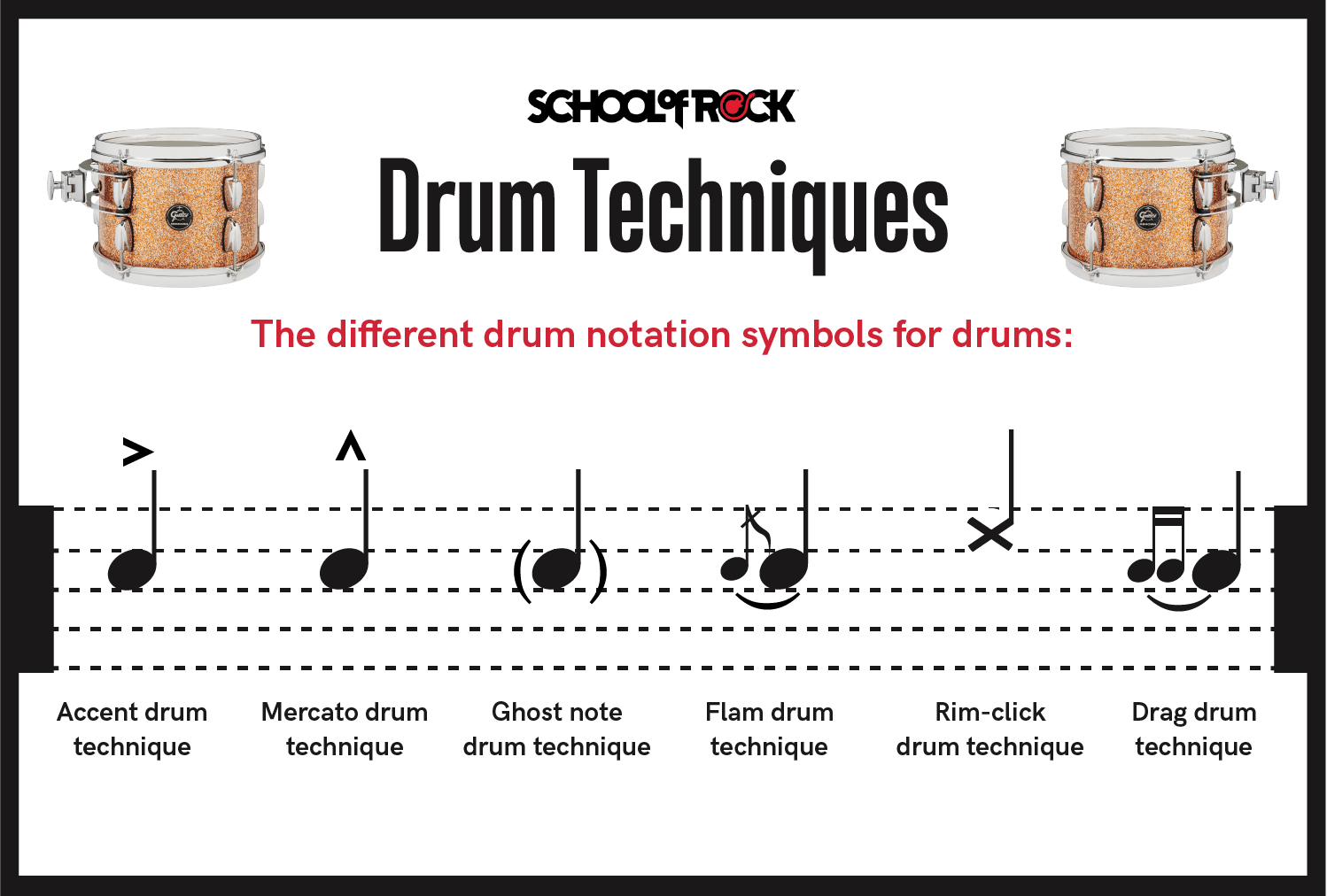
What is an emphasis pulsate technique?
Drummers have the ability to "accent" different parts of rhythms past making certain notes sound louder, softer, lower, or higher, or by using a unlike part of the drum set.
An example of an emphasis is when the drummer opens the hi-hat during a drum beat and strikes it, and so presses back downwardly on the pes pedal to close it, creating an open up-and-closed-sounding rhythm. The accent symbol is normally located straight in a higher place the note being accented.
What is a marcato drum technique?
A marcato technique is represented by one note beingness played more loudly or more forcefully than others surrounding it. This is a good way to accent notes in a drum beat. It's displayed every bit a vertical wedge to a higher place the intended note written on the page.
What is a ghost note pulsate technique?
Ghost notes are often played as light, boisterous notes on a snare drum that can sound similar many quick notes played in succession. This technique is often used in drum beats to help create more than rhythmic movements inside a piece of music, and tin be played with both the correct and left easily.
What is a flam drum technique?
A flam annotation is created when a drummer strikes a drum with both easily simultaneously while placing the notes slightly apart from each other. Information technology sounds similar two notes, but they're very close together and feel like one note.
What is a drag drum technique?
A basic elevate rudiment is played by having one hand quickly strike 2 notes on the pulsate, followed by a single stroke with the other hand. When played tightly and quickly, you lot will go three notes that sound shut together. Accent the last annotation in the drag rudiment to create a "completed" sound.
What is a rim-click drum technique?
A rim-click, or cross-stick, technique is employed when the drummer places the stick across the drum and taps the rim. Y'all can strike the rim using the shoulder of the stick or can fifty-fifty turn the stick around and utilize the bottom side. Each gives a unlike audio. This technique is oftentimes used in soft, quiet pieces of music.
Knowing how to striking cymbals
When setting up your drum set, you have many options for selecting your cymbals. Depending on what you play, you may encounter any of the following techniques while reading drum notation.

Striking the cymbal or hi-chapeau
The hullo-hat is one of the main fourth dimension-keeping tools for a drummer. By pressing your foot down on the pedal, yous can create a tight audio between the 2 cymbals. The more than you release pressure on the pedal, the more of a "washy" audio your hi-hat will make.
What is a crash bell drum technique?
You tin can use the bell of a cymbal to accent a part more than loudly. Drummers oft use the shoulder of the pulsate stick to bring out the volume of the bell.
What is a choke crash drum technique?
A choke crash technique is used when muting a cymbal subsequently information technology's been hit. This often creates a "tight" experience in music if performed alongside unlike instruments. To do this, y'all will first strike the cymbal (often a crash cymbal) every bit normal then immediately grab it with one of your hands to quickly reduce its sound.
What is a red china pulsate technique?
A china cymbal is often used equally an alternative to a loud crash cymbal. It sounds very heavy and "trashy." This cymbal tin can exist used to emphasis loud sections in a piece of music.
What is a splash drum technique?
A splash cymbal is a very small cymbal used to accent calorie-free sections in a piece of music. Because of its small size, the notes don't last as long as those of a ride or crash cymbal. Therefore this cymbal can be used to add a lot of versatility to lighter dynamic sections in music.
What is an open up hi-lid drum technique?
An open up hi-chapeau is ofttimes played by taking your pes off the howdy-hat pedal and assuasive the cymbals to bounce off each other. This is typically used in loud sections of music.
What is a closed hi-hat drum technique?
A closed hi-chapeau technique is the opposite of an open hi-hat: The ii cymbals are tightly pressed against each other past pressing down on the pes pedal to create a very tight, well-baked audio.
What is a loose hi-hat drum technique?
A loose hi-hat technique is in between a closed and open technique. You volition typically press down lightly on the foot pedal, allowing the ii cymbals to bounce off each other, but not so much that they resonate for a long time. Yous tin use this technique to create a louder dynamic inside a piece of music.
Play drums in existent performances onstage
Our music programs are taught by practicing musicians with the experience you need to learn to play. Perform live shows and develop your skills in a supportive learning environment for all skill levels.
Learn tp play
Other drum techniques
When information technology comes to playing the drums, the heaven's the limit. These are only a small sample of the many pulsate techniques you make encounter while reading drum note.
What are soft one-handed rolls?
A soft ane-handed roll is played by lightly hitting the drum and then letting the bottom of the stick remainder against the rim, followed by billowy the stick dorsum toward the drum to get a 2nd stroke. This technique tin be used to achieve more than notes chop-chop with 1 hand.
What are absolute ane-handed rolls?
An absolute one-handed curl is the aforementioned as the above but contains an accent with one of the notes. Yous tin strike either of the ii notes more loudly or softly than the other to create a unique rhythm.
Tips for Beginning to Read Pulsate Notation
When starting to read pulsate notes, it'due south of import to consider the following helpful tips to ensure you encounter success.
1. Pause the lesson down into smaller pieces.
When learning a new song on drums, separate its sections into unique groups and work on them one at a time. Then connect them together. This trick will help you memorize the parts of the song more chop-chop.
2. Take information technology boring.
New drummers need to develop coordination betwixt their limbs. Learning drums is merely as much of a mental challenge as it is a physical challenge. A adept method for new drummers is to do rudiments and paradiddles taught in our pulsate lessons so that yous can learn unlike patterns of right and left strokes on the drums.
Much like learning how to play a video game for the kickoff fourth dimension, your brain needs to learn right and left striking patterns. This tin have time, so patience is important.
3. Fix fourth dimension aside to practice every day.
Beginner drummers demand to train their brains to use their limbs in new ways. Setting aside time every solar day to practice will assist reinforce good habits and lead to more consistent improvement than doing longer, less-frequent do sessions.
4. Consider pulsate notation software.
Drum note software is a helpful tool when learning how to read and write music. As you acquire the language, consider using different applications to aid you grasp new concepts behind the drums prepare. A metronome is likewise a necessary tool for new drummers to help locate the beat out and go along steady fourth dimension. Tempo control will improve tremendously when a metronome is used in students' exercise routines.
five. Employ words to make rhythms easier.
For beginners, learning to read drum notation is a lot similar learning a new language. Employ associations early on to call back what certain things mean on the drums. For example, sure words incorporate syllables that are applicable to different rhythms.
- The word "pizza" can exist used to retrieve how to play eighth notes.
- The give-and-take "cheese" tin can stand for quarter notes.
- "Pepperoni" tin can be used for sixteenth notes,
- "anchovy" for triplets, etc.
Ready to become started?
Now that you know the nuts of how to read drum notation for beginners, how to tell the difference between it and drum tab note, and some fundamental drum techniques, you're ready to first playing. From beginner to avant-garde, School of Rock has taught thousands of students how to play drums and reach their full potential. Our instructors accept the knowledge and feel to accept you rapidly playing your favorite rock songs onstage.
School of Rock students likewise proceeds access to a wealth of information, including our Method Books and Method App, which are utilized by our qualified instructors to teach a consummate music education in a fun way.
Source: https://www.schoolofrock.com/resources/drums/drum-notation-for-beginners
0 Response to "How to Read Marching Band Bass Drum Line Sheet Music"
Post a Comment